 Book now
Inside the Bodleian Library's 60-minute tour: the four rooms, one by one
A carved Gothic hall, a parliament house, a university courtroom and a reading room that opened in 1488. What to look for in each, in the order you see them.
The 60-minute tour of the Bodleian Library is a walk through five centuries of Oxford in four rooms. It starts in a fifteenth-century hall built for teaching and examining, passes through two seventeenth-century chambers where the University governed and judged itself, and ends upstairs in the reading room that gave the Bodleian its start. This guide takes the rooms in the order the tour does, with the details worth looking for in each, so that an hour that goes very quickly stays with you afterwards.
Before you start: the Old Schools Quadrangle and the Proscholium
You reach the tour through the Old Schools Quadrangle, built between 1613 and 1624 to replace what Thomas Bodley called the ruinous little rooms where undergraduates had been taught. Look at the doorways around the courtyard: the painted inscriptions above them name the old schools, the subjects once lectured in each room, from natural philosophy to music. By 1859 the whole quadrangle had been taken over by the library.
The tower on the east side, above the Great Gate, is known as the Tower of the Five Orders. Its columns climb through the five orders of classical architecture, Tuscan at the bottom, then Doric, Ionic, Corinthian and Composite. In 1769 the astronomer Thomas Hornsby watched the transit of Venus from it.
Opposite the gate, a bronze statue stands in front of a set of glass doors. Behind them is the Proscholium, the entrance hall of the Divinity School and the meeting point for every library guided tour. Above it, out of sight, is Arts End, the first extension Bodley added to the library in 1610–12.
Room one: the Divinity School
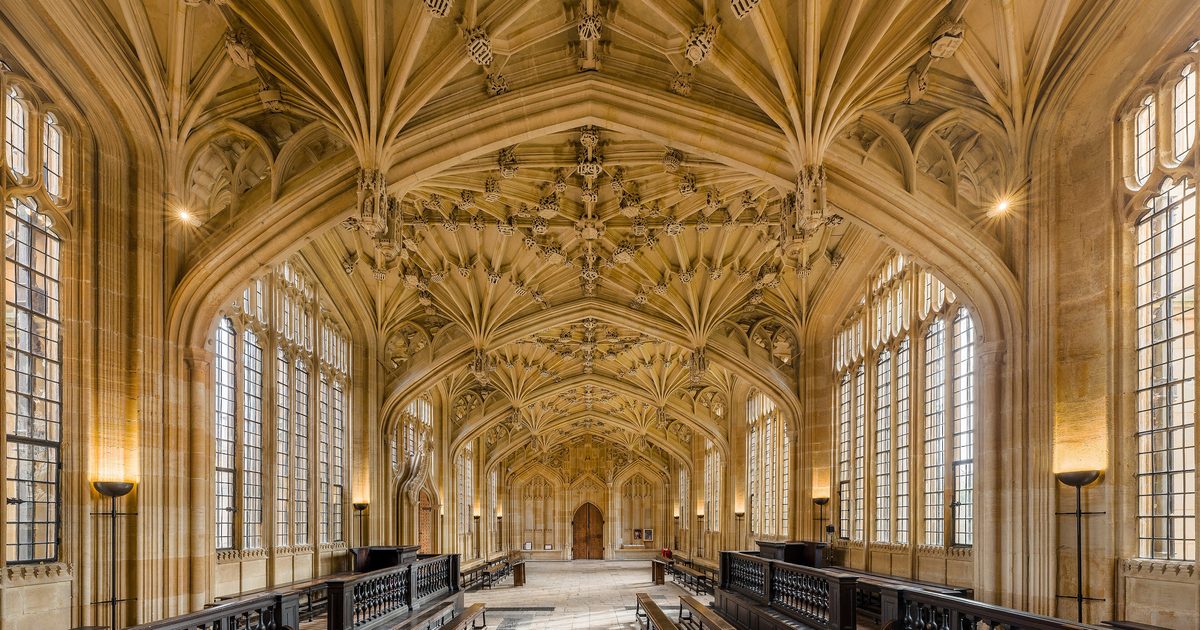
The Divinity School took most of the fifteenth century to finish. The library dates it to 1424–1488, and calls it a masterpiece of English Gothic architecture. It was built as the University's teaching room for theology, and it is the University's oldest teaching room and its first examination school, where students sat oral examinations and argued points of theology.
The ceiling is the reason people stop talking when they walk in. It is a stone vault of extraordinary density, and the library counts over 400 crests and other images carved into it. The bosses are attributed to the master mason William Orchard in the 1480s.
Look down as well as up. The benches and the pulpits along the sides are where students and tutors once debated, and the furnishings date back to 1669. The tall windows on both long walls make this the brightest of the four rooms, which is useful: some of the others are kept quite dark.
If the hall looks familiar, it may be from the cinema. The library notes that the Divinity School appears as the infirmary in the Harry Potter films. Your guide will usually have a story or two, but the building was famous long before the films, and the stonework rewards a slow look more than a quick photo.
Room two: Convocation House
A door at the far end of the Divinity School leads into Convocation House, added in the seventeenth century. The library describes it as a fine example of an original seventeenth-century parliament house, with a stone fan-vaulted ceiling built in a medieval style. Dark wooden benches line the walls, facing one another across the floor in the manner of a debating chamber.
For over 300 years this was where Convocation and Congregation, the University's two governing bodies, met to make decisions. It was also briefly a seat of national power. During the seventeenth century the English Parliament met in this room three times, and while Charles I held court in Oxford during the Civil War, the parliament he summoned there sat here.
Above Convocation House is Selden End, the western extension of Duke Humfrey's Library completed in the 1630s. You will see it from the inside at the end of the tour, which helps make sense of how these buildings fit together: the library grew upwards and outwards over the rooms below it.
Room three: Chancellor's Court
Next to Convocation House is Chancellor's Court, the University's former courtroom. It has a fan-vaulted ceiling of its own and an oak-panelled dock from the 1630s, and it still feels like a room built to make people uncomfortable.
For centuries the University kept its own court and disciplined its own members. Students were put on trial here for misdemeanours and high spirits of every kind, and the library's favourite example is a student called Oscar Wilde, summoned during the 1870s for failing to pay his bills.
Chancellor's Court is one of the two rooms that the 60-minute tour adds to the library's shorter visits, together with Convocation House. It is a small room, and a vivid one: the place where the University judged its own.
Room four: Duke Humfrey's Library
The tour ends upstairs, in the room that started it all. Duke Humfrey's Library sits on the first floor directly above the Divinity School. It was built to hold the manuscripts given by Humfrey, Duke of Gloucester, a younger brother of Henry V, who gave the University more than 281 manuscripts, including several important classical texts. The University began the room over the new Divinity School in 1478 and opened it in 1488.
Its first life was short. In 1550, during the purge of what reformers called superstitious books, the library's contents were removed and some were burnt; in 1556 the empty room passed to the Faculty of Medicine. Only a handful of Humfrey's own books survive in the collection today. The room was saved by Thomas Bodley, who refitted it from 1598 and reopened it to scholars on 8 November 1602.
Look up first. The ceiling is made of painted panels bearing the arms of the University. Then look along the walls: the oak bookcases in the oldest part stand at right angles to the walls, with desks built in, so that readers worked between the cases. Historically the books here were chained to the shelves, and even now they can only be consulted in the Bodleian's reading rooms. You will also see a reading booth built for King Charles I.
From the medieval centre, the room opens into Arts End at one end and Selden End at the other, the extensions of 1610–12 and 1634–37, so that from above the library forms an H. Film fans may recognise it as the Hogwarts library in the Harry Potter films. Remember as you walk that Duke Humfrey's is still a reading room. People may be working at the desks; that is why voices drop and why the group is never larger than 14.
Reading the building as one plan
It helps to picture the Old Library as a stack. On the ground floor, in a line, sit the Proscholium, the Divinity School and Convocation House, with Chancellor's Court close by. On the first floor, directly over them, runs Duke Humfrey's Library: Arts End above the Proscholium, the medieval room above the Divinity School, and Selden End above Convocation House. The tour walks the ground floor first, then climbs the stairs and sees the same footprint again from above.
The order of building follows the order of need. The Divinity School came first, with the library added on top for Humfrey's books. When Bodley's collection outgrew the room, he extended it at the east end; when John Selden's gift of 8,000 books arrived, the west end followed, with Convocation House built underneath it. The quadrangle around them all was the last part of Bodley's plan, finished after his death.
Why the rooms feel the way they do
Some details on the tour make more sense once you know how the library was run. Bodley's rule was that no book left the building, and it held: in 1645 even Charles I was refused permission to borrow one. Readers worked where the books were, which is why the old cases have desks built into them.
Comfort came late. The library had no heating until 1845 and no artificial lighting until 1929, and in 1831 it averaged only three or four readers a day, opening from 10am to 3pm in winter. The library still describes some of its historic rooms as quite dark, and that low light is not far from how Duke Humfrey's has always been.
What the tour does not include
The 60-minute tour stays inside the Old Library. It does not go into the Radcliffe Camera, the round, domed library in Radcliffe Square, which is a separate working library with its own tours, and where photography is not allowed. You will pass it on your way in or out, and its exterior is one of the best sights in the city.
Nor does it cover the Weston Library across Broad Street, which you do not need a ticket for. Its ground floor, Blackwell Hall, holds the library's free exhibitions, the café and the main shop, and it is worth an extra half hour before or after your tour.
How the hour feels
Sixty minutes across four rooms means roughly a quarter of an hour in each, though the guide sets the pace, and the Divinity School and Duke Humfrey's tend to get the most time. The group moves together and stops to listen; you stand for most of the tour. There are stairs to climb to reach Duke Humfrey's Library, and no lift.
The tour is spoken in English, and the guides can give you a written translation if you ask before it begins. Questions are welcome. In Duke Humfrey's Library, keep them for the guide and keep your voice low, because people are reading.
Taking photos well
Photography for personal use is allowed on the tour, with a few rules: no flash, no tripods or selfie sticks, no video cameras, and no photographs of readers or staff. The bright Divinity School is the easiest room to photograph; Convocation House and Chancellor's Court are darker, and Duke Humfrey's Library is dim.
Two tips. In the Divinity School, stand near the entrance and frame the full length of the hall to catch the vault receding towards the far door; it is the view in most of the photographs you will have seen. In Duke Humfrey's, look for the painted ceiling rather than the readers, and accept that this is a room better remembered than photographed.
Before you go
Everyone on the tour must be 11 or over, children must come with an adult, and every visitor needs their own ticket. Tickets are released online at 9am UK time on the 1st and 15th of each month and often sell out, so book as soon as your date is on sale, or hold it with us if it is not.
On the day, walk through the Great Gate on Catte Street into the Old Schools Quadrangle and go through the glass doors behind the statue. Arrive a few minutes early, keep your bag small, and give yourself time afterwards to stand in the quadrangle and look back at the rooms you have just walked through.
Frequently asked
Which room is the highlight?
Most visitors would say Duke Humfrey's Library, where the tour ends, though the vault of the Divinity School is the most photographed room.
Is the Divinity School really in Harry Potter?
Yes. The library says it appears as the infirmary in the Harry Potter films.
Do we go inside the Radcliffe Camera?
No. The Radcliffe Camera has its own separate tours; the 60-minute tour stays in the Old Library.
Are there stairs?
Yes. Duke Humfrey's Library is up a flight of stairs and there is no lift.
How long is spent in each room?
The guide sets the pace; roughly 15 minutes a room is a fair guide, with more in the Divinity School and Duke Humfrey's.